
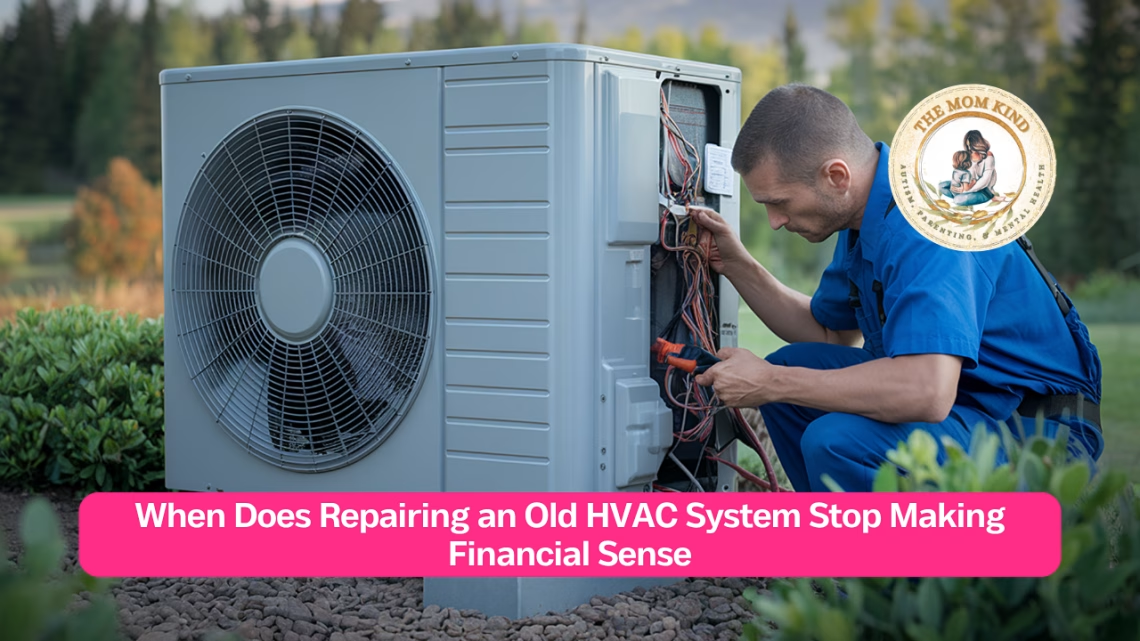
Deciding whether to repair or replace an aging HVAC system can be difficult, especially when a breakdown turns into an HVAC emergency. The HVAC repair or replace decision becomes easier when homeowners consider the system’s condition, repair history, operating costs, and remaining service life rather than focusing only on the latest repair bill.
Signs HVAC System Needs Repair Or Replacement
An HVAC system usually needs professional attention when its performance changes in a noticeable or persistent way. Changes in comfort, airflow, humidity, or indoor air quality can all indicate that the system is no longer operating as it should.
Homeowners should pay particular attention to sudden changes. A system that ran normally last season but now struggles to cool the house, runs almost continuously, or causes a sharp increase in electricity use may have a mechanical, refrigerant, airflow, or control problem that should be diagnosed before it causes additional damage.
The most useful sign is not simply that something has gone wrong. It is whether the system has stopped behaving predictably. An HVAC system that needs attention often starts developing a pattern: longer recovery times after the thermostat changes, wider temperature swings, repeated lockouts, more frequent cycling during mild weather, or noticeably different performance from one season to the next.
Homeowners should also watch for problems that return after service. If a system repeatedly loses refrigerant, freezes up, overheats, trips a safety control, or develops the same airflow complaint after being repaired, the important issue is no longer the individual symptom. The unresolved cause may be shortening the life of other components.
A single problem does not automatically mean the system needs replacement. A failed capacitor, clogged drain, dirty coil, worn contactor, or faulty thermostat can often be repaired economically. Replacement becomes more likely when several problems occur together, especially on an older system with declining efficiency or a history of expensive repairs.
Before deciding whether to replace or repair an HVAC system, ask what changed, why it changed, and whether the proposed work corrects the cause or only restores operation temporarily.
Signs You Need HVAC Repair
The most common signs that an HVAC system needs repair include warm air from the vents while the air conditioner is running, weak or inconsistent airflow, frequent starting and stopping, unusual rattling, buzzing, grinding, squealing, or clicking, uneven temperatures between rooms, higher energy bills without a major change in weather or usage, water leaking near the indoor unit, ice forming on refrigerant lines or the evaporator coil, unusual musty, burning, or electrical odors, a thermostat that does not match the actual indoor temperature, and a system that runs for long periods without reaching the thermostat setting. These are among the most common signs you need HVAC repair rather than simply routine maintenance.
Some symptoms can have several causes. Weak airflow, for example, could come from a dirty filter, duct restriction, blower problem, or frozen coil. Because the visible symptom does not always identify the underlying failure, a proper diagnosis is more useful than replacing individual parts based on guesswork.
Some of the best repair clues appear before the system completely stops working. One is increasing recovery time. If the home used to cool from 78°F to 74°F fairly quickly but now takes much longer under similar outdoor conditions, something may have changed in capacity, airflow, refrigerant performance, or heat transfer. Changes like these can be early signs you need HVAC repair even when the system is still operating.
Another is abnormal cycling during moderate weather. A system that starts and stops constantly when outdoor conditions are mild may have a control, airflow, sizing, or equipment problem.
Homeowners can also notice changes at startup. New vibration, delayed blower operation, unusually loud compressor starts, or lights dimming more noticeably than before can justify an inspection even if the system is still producing heating or cooling.
Recurring resets are another overlooked warning sign. If power cycling the thermostat or breaker has become a routine way to get the equipment running again, the system is already telling you that a fault needs diagnosis.
Burning smells, electrical odors, repeated breaker trips, smoke, or severe mechanical noises should be treated as urgent issues. These are especially important signs you need HVAC repair. Shut the system off and have it inspected before operating it again.
Signs Your HVAC Needs To Be Replaced
Replacement becomes easier to justify when the system has reached an age where major repairs are increasingly likely and its overall performance is declining.
Strong replacement indicators include an HVAC system that requires frequent service calls, has experienced multiple major component failures, needs a compressor, heat exchanger, coil, or similarly expensive repair, no longer keeps the home consistently comfortable, runs for unusually long periods, has become noticeably more expensive to operate, has significant refrigerant-related problems, uses an older refrigerant that may make future repairs more complicated or expensive, has extensive corrosion, leaking coils, or deteriorated components, is substantially oversized, undersized, or poorly matched to the home, or is nearing the end of its expected service life. When several of these conditions occur together, they can be strong signs your HVAC needs to be replaced.
Age alone should not determine the decision. A well-maintained older system with a minor, inexpensive problem may still be worth repairing. A younger system with a failed compressor, persistent refrigerant leaks, poor installation, or repeated major repairs may warrant replacement sooner.
Replacement also becomes easier to justify when the equipment has become difficult to support. Parts may still technically exist, but long lead times, discontinued control boards, proprietary motors, or refrigerant-related service limitations can turn the next breakdown into a prolonged outage. These support problems can become signs your HVAC needs to be replaced when future repairs are likely to be slow or unusually expensive.
Another strong indicator is a system whose performance cannot be corrected economically because the original installation has fundamental problems. Poor equipment sizing, mismatched indoor and outdoor units, inadequate return air, or equipment that was never properly commissioned can make repeated repairs a poor use of money.
When To Repair Vs Replace HVAC System
Repair usually makes sense when the system is relatively young, has otherwise performed reliably, and the repair addresses a specific problem without requiring a large investment. The HVAC repair or replace question is therefore less about age alone and more about what condition the equipment will be in after the repair.
Homeowners should ask the technician whether the proposed repair restores the system to good overall condition or simply fixes the next failing component. When deciding whether to repair or replace HVAC equipment, a useful repair-or-replace decision asks one question that is often missing from estimates: How much risk remains after the repair?
Ask the contractor to separate the system into what has failed now, what is still in good condition, and what appears likely to become the next significant expense. That creates a much better picture than comparing the repair invoice with the replacement price.
For example, spending several hundred dollars on a blower motor for an otherwise dependable system may be reasonable. Spending several thousand dollars on a compressor when the system also has an aging coil, declining efficiency, and a history of refrigerant leaks may provide poor long-term value. A $1,200 repair can be a good decision if it restores a healthy system with several dependable years ahead. A $700 repair can be a poor decision if the technician already sees a deteriorating coil, worn blower assembly, recurring refrigerant problem, and obsolete controls.
It is also worth considering the consequences of another breakdown. A household with elderly occupants, very young children, home medical equipment, pets sensitive to extreme temperatures, or limited access to emergency service may reasonably place greater value on reliability.
When Is HVAC Repair No Longer Cost Effective
HVAC repair becomes less cost effective when homeowners are repeatedly spending money without gaining a reasonable period of reliable operation.
Warning signs include repair costs approaching a meaningful percentage of replacement cost, multiple service calls within a short period, one major repair followed by another, expensive repairs on equipment already near the end of its typical lifespan, persistent refrigerant leaks, major corrosion or deteriorating coils, increasing utility costs despite regular maintenance, and replacement parts becoming difficult or expensive to obtain.
Some homeowners use simplified formulas based on age and repair cost. Those formulas can be useful as screening tools, but they should not replace an equipment-specific assessment. A better calculation for homeowners deciding whether to repair or replace HVAC equipment considers the repair cost, expected remaining service life, probability of additional failures, replacement price, efficiency difference, warranties, and how long the homeowner expects to remain in the property.
Repair becomes financially weak when each dollar spent buys less dependable operating time. Homeowners can think in terms of “cost per expected year,” even if the estimate is approximate. A $1,500 repair that provides another five dependable years may represent good value. The same $1,500 repair on a system likely to need another major repair next year may not.
Another warning sign is diagnostic uncertainty. If several parts are being replaced experimentally without a clear explanation of the underlying failure, repair costs can accumulate quickly without improving reliability.
Repeated refrigerant additions deserve particular scrutiny. Refrigerant is not normally consumed during operation. If a system requires repeated recharging, the financial question should include finding and correcting the leak rather than simply paying for another temporary refill.
Repair may also become uneconomical when downtime has a real cost. Waiting days for an obsolete part during peak summer or winter can matter just as much as the repair price itself.
Is It Cheaper To Repair Or Replace HVAC System
Repair is almost always cheaper in terms of the immediate invoice. Replacement can be cheaper over the longer term when an aging system requires repeated repairs or consumes substantially more energy than a properly sized newer system.
The comparison should therefore be based on total ownership cost rather than the price of today’s service call. A homeowner considering a $2,000 repair should compare the current repair cost, expected maintenance and repairs during the next three to five years, current annual energy use, estimated energy use with replacement equipment, available manufacturer or contractor warranties, rebates, tax incentives, or utility programs that may apply, and financing costs, if applicable.
A better comparison looks at current repair cost + likely near-term repairs + operating cost + outage risk versus replacement cost + financing cost, if any + expected operating cost – applicable incentives.
Energy savings should be treated realistically. Replacing an inefficient system can reduce operating costs, particularly when the existing equipment is old or performing poorly, but energy savings alone do not always recover the full replacement cost quickly.
The strongest financial case for replacement usually combines several advantages: avoiding a major repair, reducing the risk of another failure, improving efficiency, receiving new-equipment warranty coverage, and improving comfort.
There is another financial factor homeowners often miss: spending money on an old system does not increase its value dollar for dollar. Installing a $2,500 component in aging equipment does not create a system worth $2,500 more. The homeowner still owns equipment with the same age, remaining original components, and limited remaining service life.
That does not make the repair wrong. It simply means the decision should be based on the useful service the repair is expected to provide, not on recovering the money later.
Age, Repair History, And HVAC Repair Or Replace
These three factors are most useful when evaluated together. They can help a homeowner determine whether to replace or repair an HVAC system without relying on one factor alone.
Age provides context. Older equipment generally has fewer remaining years in which a major repair can deliver value. It may also contain multiple components approaching the end of their service lives. Age is most useful when combined with what has already been replaced. Two 14-year-old systems can have very different risk profiles. One may still contain almost all of its original major components. Another may already have a newer blower motor, control board, capacitor, and coil.
Repair history shows whether the current breakdown is isolated or part of a pattern. A system that has operated reliably for many years and suddenly needs one manageable repair is very different from a system that has required a compressor contactor, blower motor, refrigerant recharge, capacitor, and coil repair within a few seasons. Repair history should therefore be examined component by component rather than simply counting service calls. The pattern of the repairs matters too. Several unrelated minor repairs over ten years can be normal. Several refrigerant, compressor, coil, or electrical failures within two seasons may indicate a more serious decline.
Energy bills can reveal declining performance. If HVAC-related electricity or fuel use has increased even after accounting for weather, thermostat settings, utility rates, and changes in household use, the equipment may be operating inefficiently. Homeowners should avoid comparing only the dollar amount on utility bills because rate increases can make an efficient system appear more expensive. Comparing actual electricity consumption in kilowatt-hours or gas usage over similar weather periods provides a more meaningful picture.
Homeowners should also consider whether the equipment is actually responsible for higher energy use. Duct leakage, attic insulation problems, air leakage, thermostat schedules, damaged ductwork, or changes in household occupancy can increase HVAC consumption even when the equipment itself is working correctly.
When high age, frequent repairs, and increasing energy consumption occur together, replacement generally becomes much easier to justify. Combined with recurring major failures, these can become some of the clearest signs your HVAC needs to be replaced.
Replace Or Repair An HVAC After Major Failure
Major component failures deserve a broader evaluation because the repair can represent a substantial portion of the system’s remaining value. When homeowners need to replace or repair an HVAC system after a major failure, examples to consider include failures involving the compressor, evaporator coil, condenser coil, heat exchanger, variable-speed blower assembly, or major control electronics.
Repair can still make sense when the equipment is relatively young, the remaining components are in good condition, the failed part is covered by a meaningful warranty, labor costs are reasonable, there is no history of recurring failures, and the system is correctly sized and otherwise performs well. Warranty coverage can change the calculation significantly. A major component covered by a manufacturer parts warranty may make repair attractive, although labor, refrigerant, shipping, and related materials may still be the homeowner’s responsibility.
Replacement becomes more attractive when the major failure occurs on older equipment, particularly when other components show wear or when the system has already required expensive repairs.
A compressor replacement provides a good example. Replacing the compressor may restore cooling, but it does not renew the evaporator coil, condenser coil, blower, electrical components, or other aging parts. Homeowners should ask what condition those components are in before investing heavily in one repair.
After a major failure, homeowners should ask whether the failure was isolated or whether it damaged, stressed, or contaminated other parts of the system. Compressor failures are a good example. Some failures are straightforward mechanical events. Others can introduce contaminants or indicate operating conditions that may affect the refrigerant circuit. The quality of the diagnosis and repair procedure matters considerably.
The same principle applies to blower motors and control boards. If a motor failed because of excessive static pressure or a control board failed because of an unresolved electrical issue, replacing the component without correcting the cause may simply start the same cycle again.
For furnace heat exchanger problems, safety is especially important. A damaged or compromised heat exchanger requires professional evaluation, and replacement may be preferable depending on the furnace’s age, condition, repair cost, and manufacturer coverage.
With split HVAC systems, compatibility matters too. Replacing only one side of an older matched system can create efficiency, capacity, refrigerant, control, or warranty complications. Homeowners should ask whether a partial replacement would produce a properly matched system.
Final Factors Before You Repair Or Replace HVAC
Before making the decision, homeowners should consider the full condition of the system rather than focusing only on the failed part. The HVAC repair or replace decision should account for equipment age and expected remaining service life, the cost of the current repair, the frequency and cost of previous repairs, the condition of other major components, current comfort and humidity performance, energy consumption, the availability and cost of replacement parts, refrigerant type and refrigerant-related repair history, existing equipment warranties, warranty coverage on proposed replacement equipment, whether the current system is properly sized, ductwork condition and airflow problems, installation quality, expected length of home ownership, and replacement incentives, rebates, and financing terms.
It is also worth requesting both a repair estimate and a replacement estimate when the repair is substantial. Ask the contractor to explain what is failing now, what caused it to fail, whether the repair corrects that cause, what other components show measurable deterioration, which expensive components remain original, and what risks remain after the repair. Homeowners should also know how long the repair itself is warranted and whether any of today’s repair cost would apply toward replacement if the system fails again soon.
For replacement quotes, homeowners should compare more than efficiency ratings. Proper load calculations, equipment sizing, airflow, duct condition, installation practices, commissioning, warranty terms, contractor qualifications, and future service support can have a major effect on how well the new system performs. Homeowners should know whether the new equipment was selected from an actual load calculation, whether the duct system can deliver the required airflow, whether every major component will be properly matched, what commissioning and startup measurements will be documented, what labor warranty accompanies the manufacturer warranty, and who handles warranty service if the installing contractor is unavailable.
Homeowners should also consider timing. An aging system that is still operating may provide the opportunity to compare contractors, equipment, financing, and installation details carefully. A complete failure during the hottest or coldest week of the year can force the same decision under much greater pressure. Recognizing the signs HVAC system needs repair or replacement before a complete failure can give homeowners more time to make that comparison.
The strongest repair-or-replace decision is based on the condition of the entire system, the cause of the current failure, the amount of reliability the proposed repair is likely to restore, and the quality of the replacement installation available. The best decision is the option that provides the most reasonable combination of reliability, comfort, operating cost, and expected years of service for the money spent.


